Orbit, heat, distance
Why stars twinkle but planets usually shine with a steady light, and how to tell them apart in the night sky
The flicker is not happening at the star. It is made in the last few kilometres of the light's journey, in the restless air above your head. Here is why a planet's light holds steady, when it does not, and how to use the difference to find planets yourself.
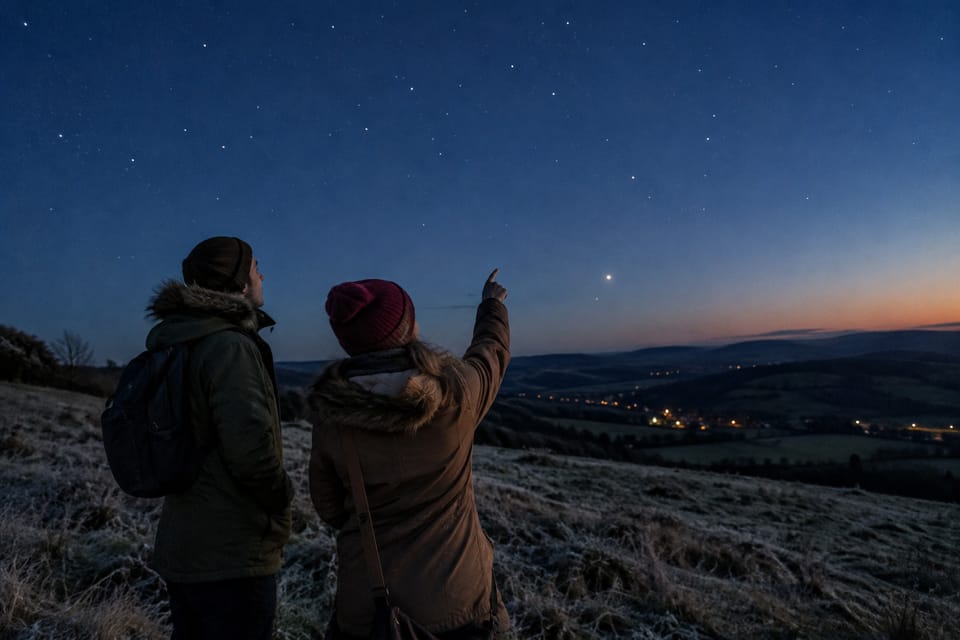
What to take away
- Twinkling, or scintillation, happens in Earth's atmosphere: moving pockets of warmer and cooler air bend starlight by slightly different amounts many times a second.
- A star is so far away that it is effectively a single point of light, so every disturbance in its narrow beam shows up as a change in brightness or position.
- A planet is close enough to show a small disc. Each point on that disc flickers independently and the flickers cancel out, so the planet looks steady.
- Everything twinkles more near the horizon, where light crosses far more air, and low bright stars such as Sirius can flash red, green and blue.
- A bright point that holds steady, sits along the Sun's path across the sky and does not belong to a familiar constellation is very likely a planet.
Stars twinkle because their light reaches us as a single, impossibly thin point, and the moving air above our heads keeps bending that point this way and that. Planets usually shine steadily because they are close enough to show a tiny disc: each part of the disc flickers separately, and the flickers average out into a calm, even glow.
Nothing about the stars themselves is flickering. Their light travels for years or centuries through the near-perfect emptiness of space without any trouble, then spends its final fraction of a second crossing Earth's atmosphere. That short last leg is where the twinkle is made, and once you understand how, you can use it to pick out planets, judge the night's observing conditions and explain why a low winter star seems to flash colours like a beacon.
What twinkling actually is
Light bends whenever it passes from one material into another with a different refractive index, which is why a straw looks broken in a glass of water. Air bends light too, only very slightly. At sea level its refractive index is about 1.0003, and the exact figure depends on the air's density, which depends mostly on its temperature. A pocket of air a few degrees warmer than its neighbour bends light a little less.
The atmosphere is never uniform. Sun-warmed ground, wind shear, weather fronts and the jet stream, which blows at around 9 to 12 km up, all stir the air into a churning mix of cells of slightly different temperature. Many of the cells that matter for starlight are only around 10 to 20 cm across. Each one acts as a weak, wobbly lens, and they drift across the line of sight with the wind.
Starlight arriving at the top of the atmosphere is a flat, orderly wavefront. By the time it reaches the ground it has been dented and rippled by thousands of these weak lenses. Some patches of the wavefront are focused slightly, others spread slightly, and the pattern shifts as the air moves. Your eye's pupil, only a few millimetres wide, samples a tiny piece of that rippling pattern. As brighter and darker patches sweep past, the star seems to brighten and fade, and sometimes to shiver from side to side, dozens of times a second.
Astronomers call the brightness flicker scintillation, and the blurring and dancing of the image seeing. They are two faces of the same turbulence. The shimmer above a hot road on a summer afternoon, or above a barbecue, is the same physics on a smaller scale, which is why distant objects seem to ripple behind it.
Why a star is the perfect target for turbulence
Even the largest stars are so far away that they appear astonishingly small. Sirius, the brightest star in the night sky, has an apparent diameter of about 0.006 arcseconds. An arcsecond is 1/3,600 of a degree, and the full Moon is about 1,800 arcseconds wide. Betelgeuse, a swollen red supergiant and one of the widest stars as seen from Earth, still spans only around 0.04 to 0.05 arcseconds.
For practical purposes, then, all the light from a star arrives along a single path through the atmosphere. Every bump in that path is felt in full. When a cooler pocket of air nudges the beam a fraction of an arcsecond aside, or concentrates it for an instant onto your pupil, there is nothing else in the image to dilute the change. The whole star brightens or dims, and the whole star jumps.
Why a planet holds steady
Planets are far closer than any star, so even though they are much smaller than stars they cover a measurable patch of sky. Jupiter spans 30 to 50 arcseconds depending on its distance from Earth, Venus anywhere from about 10 to over 60, and Saturn's globe roughly 15 to 20. Your eye cannot resolve detail finer than about 60 arcseconds, so a planet still looks like a point, but its light is in fact coming from a small disc.
Think of that disc as thousands of separate point sources packed together. Light from one edge of Jupiter takes a slightly different route through the air from light leaving the other edge, and the two routes cross different turbulent cells. One part of the disc may be brightening at the instant another is fading. Added together, the ups and downs largely cancel, in the same way that a crowd's noise is steadier than any single voice in it. The total brightness barely changes, and the planet shines with a calm, unwavering light.
The averaging works because the patch of sky over which turbulence behaves the same way is itself only a few arcseconds wide. A disc much larger than that patch is guaranteed to straddle many independent flickers. A disc close to that size gets only a little averaging, which is why the smallest planets are the most likely to give themselves away by twinkling.
| Object | Apparent size | Visible to the naked eye | Typical behaviour |
|---|---|---|---|
| Sirius and other bright stars | Under 0.01 | Yes | Twinkles, strongly when low |
| Betelgeuse, one of the widest stars | About 0.04 to 0.05 | Yes | Twinkles like any other star |
| Mercury | About 5 to 13 | Yes, low in twilight | Often twinkles, being small and always low |
| Mars | About 3.5 to 25 | Yes | Can twinkle when far from Earth, steady near opposition |
| Venus | About 10 to 66 | Yes | Steady unless close to the horizon |
| Saturn (globe only) | About 15 to 21 | Yes | Steady |
| Jupiter | About 30 to 50 | Yes | Rock steady except very low down |
| The full Moon | About 1,800 to 2,000 | Yes | No twinkle, but its edge can ripple near the horizon |
Why everything twinkles more near the horizon
Look straight up and you are looking through the thinnest slice of atmosphere available. As a star sinks towards the horizon, its light enters at a slant and crosses more and more air: about twice as much at 30 degrees above the horizon, around six times at 10 degrees, and roughly 38 times at the horizon itself. More air means more turbulent cells along the path, and the flicker builds accordingly. High stars often show a gentle shimmer; the same stars rising in the east can flicker wildly.
Low light also travels close to the ground, where the air is warmed and cooled most unevenly by buildings, fields, rivers and roofs. That is why planets, which hold steady high in the sky, can lose their composure close to the skyline. Venus sinking into a hazy western twilight sometimes twinkles noticeably, and Mercury, which never strays far from the Sun and so is always seen low, often twinkles like a star.
The same thick, layered air bends light enough to change the apparent shape of large objects. It lifts a setting Sun or Moon by a little over half a degree and squeezes it top to bottom, a separate effect from the illusion that explains why the Moon looks so much bigger on the horizon.
Why a low star flashes colours
On a clear winter evening, Sirius rising in the south-east can flash red, green, blue and white in quick succession, and it is regularly reported as a UFO for that reason. The colours are real, and they are made by the atmosphere too.
Air bends blue light slightly more than red, so near the horizon the atmosphere acts as a weak prism. The red, green and blue parts of the star's light follow paths that are separated by a few arcseconds, and they cross slightly different turbulent cells. Each colour therefore twinkles on its own schedule. When the red image happens to brighten while the blue one fades, the star looks red for an instant, then a moment later green or blue. A bright star is needed for the colours to register, because the eye sees colour poorly in faint light.
Sirius is the classic example from Britain because it is both the brightest star and always low. From London it never climbs more than about 22 degrees above the southern horizon, and from Edinburgh only about 17 degrees, so its light always crosses a long, turbulent path. Capella, which hangs low in the north on summer nights and rises in the north-east on autumn evenings, does the same while it is close to the horizon.
How to tell a planet from a star with your own eyes
Steadiness is the first clue, but it works best combined with a few others. Planets all orbit the Sun in nearly the same flat plane, a consequence of how the Solar System formed and of the gravity and motion that keep planets on their orbits. Seen from Earth, that plane traces a line across the sky called the ecliptic, the same path the Sun and, roughly, the Moon follow. Planets are always found close to it.
Star or planet: the naked-eye clues
Probably a star
- Flickers or shivers, especially when well above the horizon
- Belongs to a familiar constellation pattern you see every year
- Can sit anywhere in the sky, including far from the Sun's path
- Keeps exactly the same position relative to its neighbours from week to week
Probably a planet
- Shines with a steady light when reasonably high
- Looks like an extra bright point that does not fit the usual pattern
- Lies along the arc the Sun and Moon follow across the sky
- Drifts slowly against the background stars over days or weeks
Checking whether a bright point of light is a planet
-
Note its height
Judge whether the object is at least 30 degrees up, about three fist widths at arm's length. Below that, even planets can twinkle, and the steadiness test is unreliable.
-
Watch it for a full minute
Compare it with a star of similar brightness at a similar height. A planet stays calm while the star beside it flickers.
-
Find the Sun's path
Picture the arc the Sun followed during the day, or follow the line from the Moon towards where the Sun set. A bright steady object close to that line is a strong planet candidate.
-
Use the Sun as a reference
Venus is never seen more than about 47 degrees from the Sun, so it appears only in the evening or morning sky. Mercury stays within about 28 degrees and is always low in twilight.
-
Check it with binoculars
Steady 10x binoculars show Jupiter as a tiny disc, often with up to four pinprick moons in a line beside it. A star stays a point however you magnify it.
-
Come back next week
Mark the object's position against nearby stars. Planets, especially Mars, shift visibly over a week or two. Stars do not.
Brightness is another clue, though not proof. Venus is so bright that it outshines every star and casts faint shadows on a dark night, and Jupiter is usually the next brightest point after it. If you see a dazzling, steady white light low in the west after sunset, it is almost certainly Venus, which shines that brightly largely because its thick cloud deck reflects most of the sunlight that hits it, the same atmosphere that makes Venus hotter than Mercury despite its greater distance from the Sun.
What twinkling tells you about the night's sky
Experienced observers read twinkling as a weather report. Hard, sparkling stars often follow the passage of a cold front, when the air is crisp and transparent but full of turbulence. Those nights look spectacular to the naked eye and are excellent for wide views of the Milky Way, yet through a telescope Jupiter's cloud belts boil and Saturn's rings smear. On calmer nights under high pressure the stars sit almost still, the air is often slightly hazy, and the planets look sharp and detailed.
| What you notice | What the air is doing | Good for | Less good for |
|---|---|---|---|
| Stars sparkle hard even high up | Strong turbulence, often after a cold front or under a fast jet stream | Naked-eye stargazing, meteor watching, wide-field photos | Planets and the Moon at high magnification |
| Stars barely twinkle above 45 degrees | Calm, stable layers of air | Planetary detail, double stars, lunar close-ups | Little, though light haze may dim faint objects |
| Only low stars twinkle strongly | Normal conditions; long paths through low air | Most observing, kept well above the horizon | Anything close to the skyline |
| Stars twinkle and the sky looks milky | Moisture, high cloud or pollution plus turbulence | Bright objects only | Faint galaxies and nebulae |
Local conditions matter as well. Observing over a rooftop that has been heated all day, or through a window from a warm room, adds your own column of turbulence to the atmosphere's. A telescope taken outside needs time to cool to the night air for the same reason: warm air rising off its mirror or lens creates a miniature version of the same shimmer.
Do stars twinkle in space, and how telescopes fight the flicker
Above the atmosphere, stars do not twinkle at all. Astronauts on the International Space Station see them as perfectly steady points, and the same is true for anyone standing on the Moon, which has no air worth mentioning. This is a large part of the reason telescopes are sent into orbit: the Hubble Space Telescope's images are sharp because there is no turbulence between it and its targets.
Ground-based observatories take two approaches. The first is location. They are built on high, dry mountains with steady air flowing smoothly off the ocean, such as Mauna Kea in Hawaii, La Palma in the Canary Islands and the Atacama Desert in Chile, which put much of the turbulent lower atmosphere beneath them. The second is adaptive optics. A sensor measures how the incoming wavefront has been distorted, often using a bright guide star or a laser that makes an artificial one in the upper atmosphere, and a thin deformable mirror changes shape hundreds of times a second to undo the distortion. In effect, the telescope cancels the twinkle as fast as the air creates it.
Amateur astronomers use a simpler trick called lucky imaging. A camera records thousands of short video frames of a planet, and software keeps only the small fraction taken in moments of steadier air, then stacks them into a single image far sharper than any one frame.
Seeing it for yourself tonight
On the next clear evening, find the brightest point of light in the sky and a bright star at a similar height. Watch them side by side for a minute: one will probably sparkle and the other glow. Then look at a star rising low in the east and compare it with the same kind of star high overhead. Ten minutes of looking is enough to see the atmosphere at work, and to start recognising the planets by their calm, steady light.
Questions and answers
Why do stars twinkle more on cold winter nights?
Winter skies are often clear after cold fronts, when the air is mixed and turbulent, and the ground loses heat quickly, creating sharp temperature differences close to the surface. Winter also brings very bright stars such as Sirius, Rigel and Capella, and bright stars make the flicker easier to notice.
Can the Moon twinkle?
No. The Moon is about half a degree across, hundreds of times wider than the patches of sky over which turbulence acts, so any flicker is averaged away completely. Near the horizon its edge can look wavy or stepped, which is the same turbulence seen on a large object.
Do satellites and the International Space Station twinkle?
Most satellites shine with a steady light as they glide across the sky, which is one way to tell them from aircraft, whose navigation lights blink. Some tumbling satellites and spent rocket stages brighten and fade every few seconds as different surfaces catch the Sun, but that slow, regular pulsing is not twinkling.
Is a star that flashes red and green a UFO or an aircraft?
If it stays fixed among the other stars, rises and sets with them and does not move across the sky over a few minutes, it is a low, bright star twinkling in colour. Sirius is the most frequent culprit in winter. Aircraft move steadily and show regular, rhythmic flashing lights.
Why does Mars sometimes twinkle when other planets don't?
Mars changes size dramatically as Earth catches up with it and then pulls ahead. Near opposition it can appear about 25 arcseconds wide and looks steady, but when it is on the far side of its orbit it shrinks to about 4 arcseconds, close enough to a point that turbulence is barely averaged and it can flicker like a star.
Does twinkling mean the star is moving or about to explode?
No. Real changes in stars happen over hours, days or longer, not many times a second, and almost all are far too subtle to see without instruments. The rapid flicker is made in the air within a few kilometres of you.
Do stars twinkle in photographs?
Not as a flicker, because a camera adds up light over the whole exposure. The turbulence still shows, though: it blurs stars into slightly larger dots, and in long exposures of low bright stars the dispersion can leave faint coloured fringes.
The words used here
- Scintillation
- The rapid changes in a star's brightness, and sometimes its colour, caused by turbulence in Earth's atmosphere.
- Seeing
- Astronomers' term for how steady the atmosphere is, judged by how much it blurs and moves the image of a star.
- Refractive index
- A measure of how much a material slows and bends light; for air it is very slightly above 1 and varies with temperature and density.
- Arcsecond
- A unit of angle equal to 1/3,600 of a degree, used to describe the apparent size of objects in the sky.
- Ecliptic
- The path the Sun appears to follow across the sky during the year, along which the planets are always found.
- Adaptive optics
- A telescope system that measures atmospheric distortion and corrects it in real time with a rapidly reshaping mirror.
Keep reading
Why the Moon always shows the same face to Earth, and how we still get to see a little more than half
The Moon does spin, just at exactly the pace of its orbit. Here is how Earth's gravity set that rhythm, why the lock is not quite perfect, and how you can watch the Moon wobble from your own garden.
Why the Moon looks bigger on the horizon, and what is really going on
A rising full Moon can look enormous, yet it is no wider than the Moon high overhead. Here is what your eyes measure, what your brain adds, and how to prove it to yourself at the next moonrise.
Why Pluto is no longer classified as a planet
Pluto did not change in 2006. The definition of a planet did. Here is how the discovery of worlds beyond Neptune forced astronomers to draw a clearer line between planets and dwarf planets.
Why planets orbit the Sun, and why they keep doing it
A planet is always falling toward the Sun, but it is also moving sideways fast enough to keep missing it. Here is how gravity, inertia, energy, and the Solar System's history combine to make an orbit.